> ## Documentation Index
> Fetch the complete documentation index at: https://docs.abbyy.com/llms.txt
> Use this file to discover all available pages before exploring further.
# Multi-CPU Recognition Architecture
> Multi-CPU recognition architecture in ABBYY FineReader Engine on Windows: automatic page distribution scales recognition across cores for higher throughput.
This topic applies to FRE for Windows.
ABBYY FineReader Engine automatically combines and executes steps of distributing pages, and coordinating recognition and synthesis. That provides easy scalability and utilization of multi Core/CPU hardware and brings up to 90% of speed increase for each additional core comparing to one-core systems.
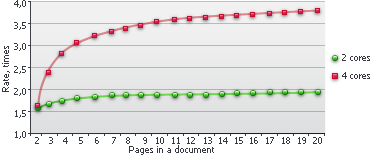 This graphic does not take into account document export step because it could vary from scenario to scenario and can’t be paralleled. Speed increase rate can also be different depending on a document complexity. For documents with complex layout it is higher, for simple — lower. The more time spent for analysis and recognition — the higher benefit from multi-processing. The graphic also shows that the more pages are in a document the more effective load balancing and performance rate.
Numbers quoted are based on internal ABBYY testing.
## See also
[Key Features](/fine-reader/engine/introduction/key-new-features)
This graphic does not take into account document export step because it could vary from scenario to scenario and can’t be paralleled. Speed increase rate can also be different depending on a document complexity. For documents with complex layout it is higher, for simple — lower. The more time spent for analysis and recognition — the higher benefit from multi-processing. The graphic also shows that the more pages are in a document the more effective load balancing and performance rate.
Numbers quoted are based on internal ABBYY testing.
## See also
[Key Features](/fine-reader/engine/introduction/key-new-features)