> ## Documentation Index
> Fetch the complete documentation index at: https://docs.abbyy.com/llms.txt
> Use this file to discover all available pages before exploring further.
# Sample 4. Step 5.2: Name of Delivery Address field, kwDeliveryAddress element
> Find the Delivery Address field name with a kwDeliveryAddress Static Text element that reads its search strings from the AddressHeaders.txt dictionary file.
Once you have examined the images, you will notice that:
* The field in question is always located on the first page, in the upper part of the page. Therefore, you can limit the search area to the first page and use absolute coordinates to specify a rectangular area.
* Use the `AddressHeaders.txt` file to search for the text.
Both the GUI and the FlexiLayout language allow you to use databases and text files to specify text lines to be found on an image. Text files can use either ANSI or Unicode encoding. Letter case does not affect the search and only serves to make the text more readable. Each search string must be placed on a separate line. Empty lines are ignored.
* You can set the maximum error percentage to 20, which in this case means no more than 3 errors in each phrase.
The optimal number of errors can only be arrived at through trial and error. For more information about Static Text elements, see [Static Text](/flexi-capture/fls/template/static-text).
To create a kwDeliveryAddress element:
1. In the **InvoiceHeader** element, create an element of type **Static Text** and name it **kwDeliveryAddress**.
2. Click the Static Text tab.
3. Select Search text from file and provide the path to the `AddressHeaders.txt` file (folder `%public%\ABBYY\FlexiCapture\12.0\Samples\FLS\English\Invoice\Dict`).\
A text file is accessed by its name, which can be either absolute or relative. Relative names are specified relative to the FlexiCapture project folder (the folder that contains the `*.fcproj` file) or the FlexiLayout Studio project folder (the folder that contains the images).
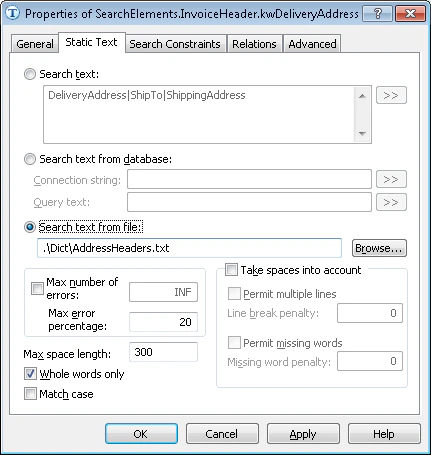 4. Set Max error percentage to 20.
5. Click the Search Constraints tab and use absolute coordinates to specify the rectangular search area on the first page:
* Select Absolute search area constraints
* In the Pages field, select Range from the drop-down list
* In the Range field, type 1
* In the Region field, specify the coordinates of the rectangle \[1, 1, 2475, 1878]
* Once you have specified the properties of the search area, click Add.... The search area will appear in the **Search areas** list
6. Click the Advanced tab and in the **Advanced pre-search relations** specify:
```text theme={null}
WholeWordMode: true;// Only whole text objects will be treated as possible hypotheses
```
7. Temporarily exclude the **InvoiceFooter** element and match the FlexiLayout.
4. Set Max error percentage to 20.
5. Click the Search Constraints tab and use absolute coordinates to specify the rectangular search area on the first page:
* Select Absolute search area constraints
* In the Pages field, select Range from the drop-down list
* In the Range field, type 1
* In the Region field, specify the coordinates of the rectangle \[1, 1, 2475, 1878]
* Once you have specified the properties of the search area, click Add.... The search area will appear in the **Search areas** list
6. Click the Advanced tab and in the **Advanced pre-search relations** specify:
```text theme={null}
WholeWordMode: true;// Only whole text objects will be treated as possible hypotheses
```
7. Temporarily exclude the **InvoiceFooter** element and match the FlexiLayout.