
Training progress graph
The graph on the left shows the percentage of correctly extracted field values across all epochs.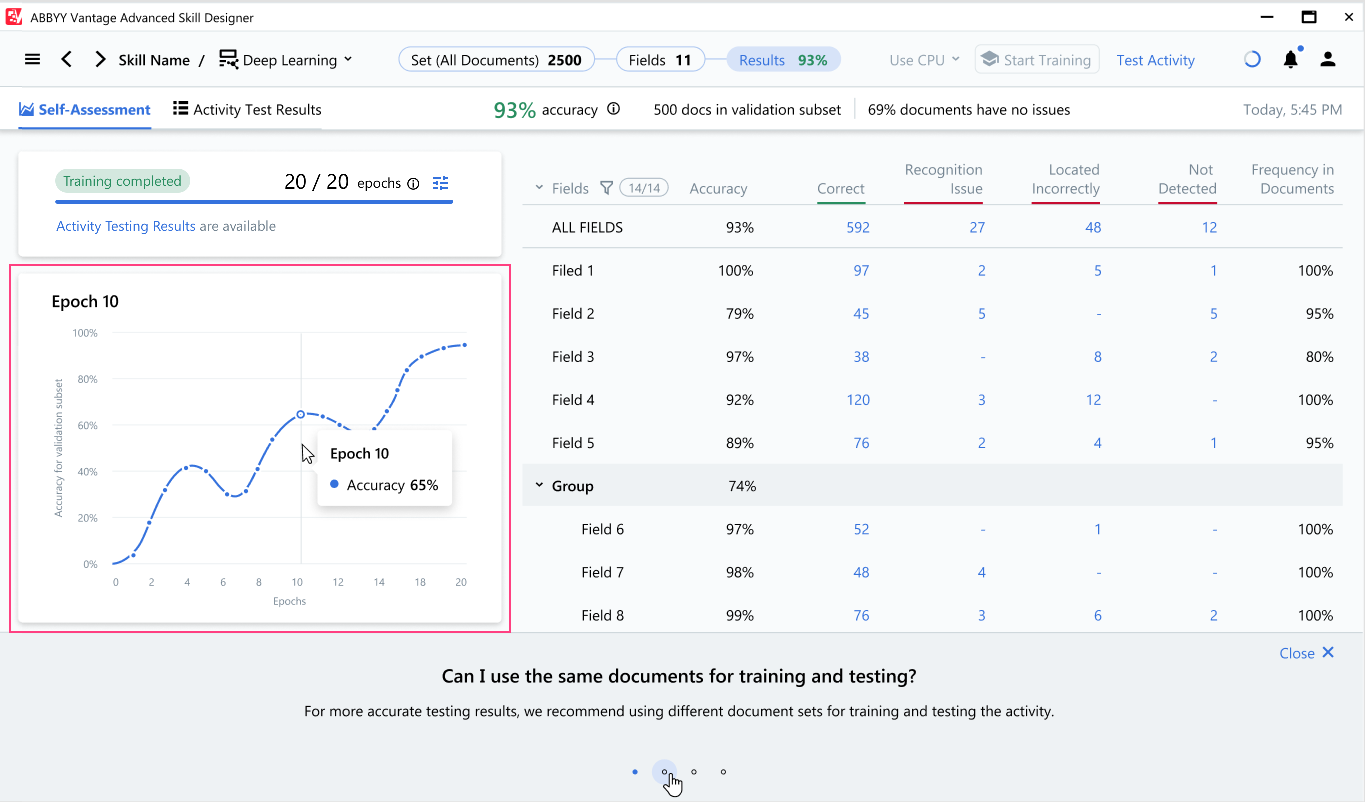
Interpret the graph
This graph can help you decide whether you should carry on with the training or stop training the activity:- If the accuracy is sufficiently high and is no longer increasing, then the training can be stopped.
- If the accuracy is not sufficiently high but is still increasing, then the training should go on.
- If the accuracy is not sufficiently high and is no longer increasing, then you should analyze the quality of extraction of individual fields (there may be fields in the documents that are too rare or that have been marked up incorrectly).
Training does not affect the quality of recognition and incorrectly detected fields can still be trained.
Decide when to stop training your activity
By default, a Deep Learning activity is trained over 20 epochs. However, in certain cases you may want to reduce the training duration or stop the training manually. You may want to stop training if:- The accuracy percentage is sufficiently high and there have not been any significant changes in accuracy for several epochs in a row.
- The accuracy percentage is low and there have not been any significant changes in accuracy for several epochs in a row (consider using a larger document set or make sure that all fields are well represented and marked up correctly).
- You want to test the activity manually on all the documents (resume the training if you are not satisfied with the field extraction results).
Adjust the training duration
You can reduce the number of epochs or the time spent on training a document set at any point during training. Document types with fewer variants take less time to train.1
Open the Self-Assessment section
Go to the Self-Assessment section of the Results tab.
2
Open the duration settings
Click the settings icon to the right of the number of epochs above the graph.
3
Enter a new limit and apply
Enter a new number of epochs and/or a time in
hours:minutes format, and then click Apply. The new limit must be greater than the number of elapsed epochs, and the maximum number of epochs is 20. Training stops once any one of the limits is reached.