
Documentation Index

Fetch the complete documentation index at: https://docs.abbyy.com/llms.txt

Use this file to discover all available pages before exploring further.

The Map Fields activity is used to save extracted field values to UiPath variables. You can map ABBYY Vantage fields to UiPath variables in the Designer panel.

Activity properties

GroupPropertyTypeDescription
Connection SettingsSkill NameStringThe name of the Vantage Document skill.
InputExtracted DataStringAccepts a JSON string containing the extracted data. Pass to this property the value of the ExtractedData property of the particular DocumentResult received in the Get Results activity. To pass values between the properties, use UiPath variables.
The Map Fields activity can only be used inside a configured Vantage Scope activity.
When configuring the activity, set the Password or Client Secret property on the Vantage Scope activity (depending on your authentication flow) so the connector can retrieve the skill list. Switch to the Secure Password or Secure Client Secret property once your workflow is configured — see Vantage Scope activity. At runtime, the Extracted Data property must receive the ExtractedData value from the DocumentResult that Get Results returned for the Document skill this Map Fields activity is configured for. Before passing the data to Map Fields:
  • Confirm the document’s Document skill matches the one configured in Map Fields. Use the ClassName property of the DocumentResult to identify the document type.
  • For ClassName to populate, configure class-to-skill mapping in the Extract activity of the Process skill — the class name must equal the Document skill name.
For more information about setting up the Extract activity, see Map Document skills to classes. To map ABBYY Vantage fields to UiPath variables:
1

Open the Map Fields activity

Open the Map Fields activity in the Designer panel and click the button to the right of the drop-down list under Skill Name to load the list of available skills.
2

Select a Document skill

Expand the Skill Name drop-down list and select the Document skill whose extracted field values must be saved to UiPath variables.
You can only choose a Document skill.
3

Refresh the field tree

Click the Refresh button. A field tree appears in the Vantage Extracted Field column.
4

Map a field to a UiPath variable

Expand the tree and click the Plus button next to a field you want to map. In the UiPath Variable column, a UiPath variable name and type appear. By default the variable name matches the Vantage field name, but you can change it if required.
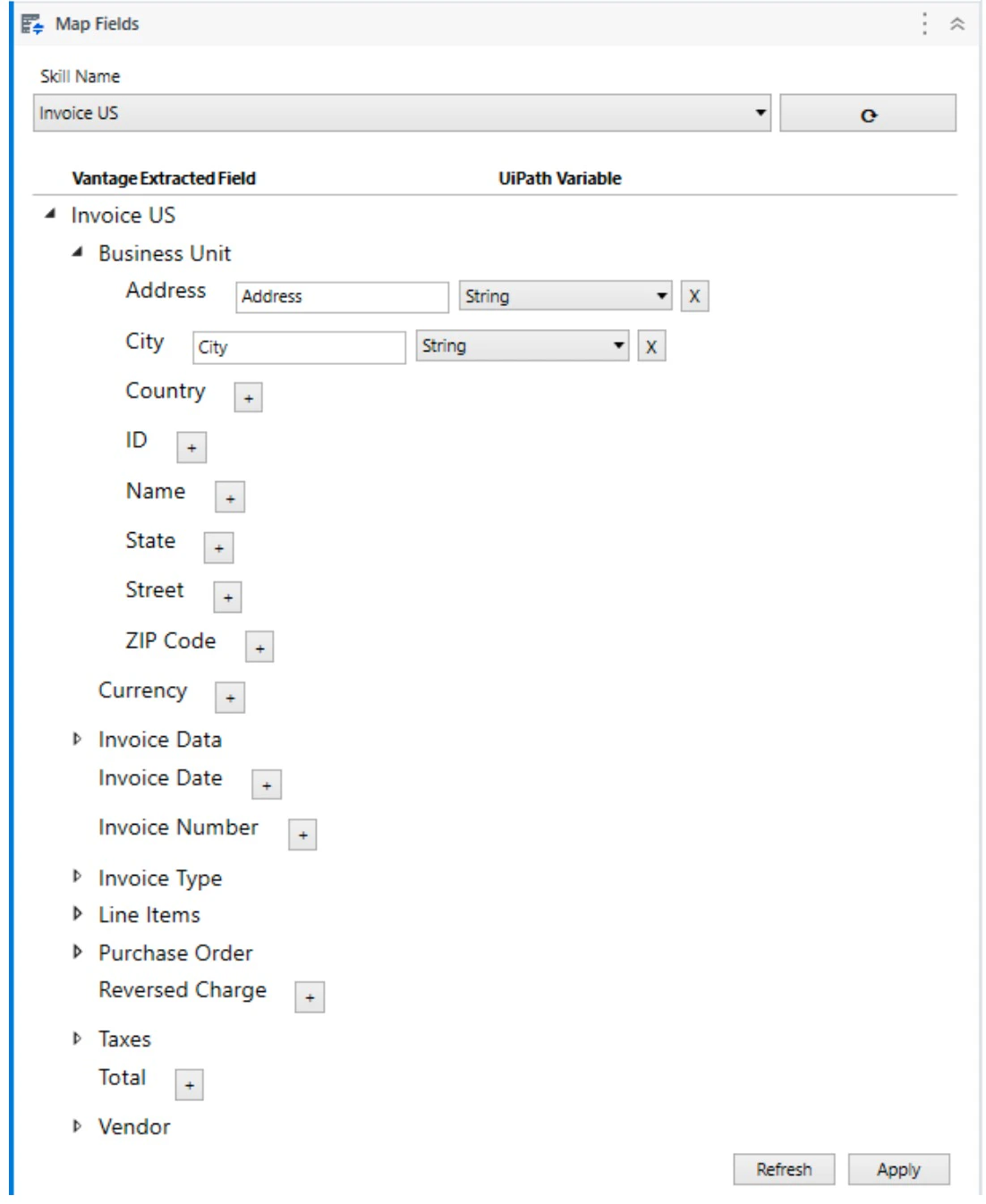
Ensure that the UiPath variable names specified in the Map Fields activity match the Variables Naming Convention configured in your UiPath process. If variable names do not follow the naming rules, they are displayed with a warning symbol in the UiPath variable list. For more about Variables Naming Convention, see the UiPath documentation.
Map Fields activity showing the Vantage Extracted Field tree and UiPath Variable column
5

Map the remaining fields

Repeat the previous step for the other fields you need to map. You can specify already-existing UiPath variables — in that case, make sure the variable type matches the one recommended in the table below.
6

Apply the mapping

After mapping your document fields to UiPath variables, click Apply to save the changes. When the Map Fields activity is called at runtime, variable values are filled in with the extracted data.
The specified UiPath variables will be created in the Sequence closest to the Map Fields activity (for example, in Flowchart).
The Skill Name parameter accepts a UiPath String variable. Selecting a Document skill from the drop-down writes the new value to the variable. Expressions and references to other variables are not supported.
The table below shows what type of UiPath variable corresponds to each ABBYY Vantage field type:
ABBYY Vantage Field TypeUiPath Variable Type
TextString
DateString
NumberString
MoneyString
BarcodeString
CheckmarkBoolean
Checkmark group (can be obtained as separated checkmarks)FieldList
GroupFieldList
Group (for repeatable groups)FieldList[]
TableFieldList[]
Repeating leaf fields (such as Text) and table columns map to String[]. Repeatable groups — including those nested inside other repeatable groups — map to FieldList[]. Within a repeatable group, you can also map individual child fields to simple types.
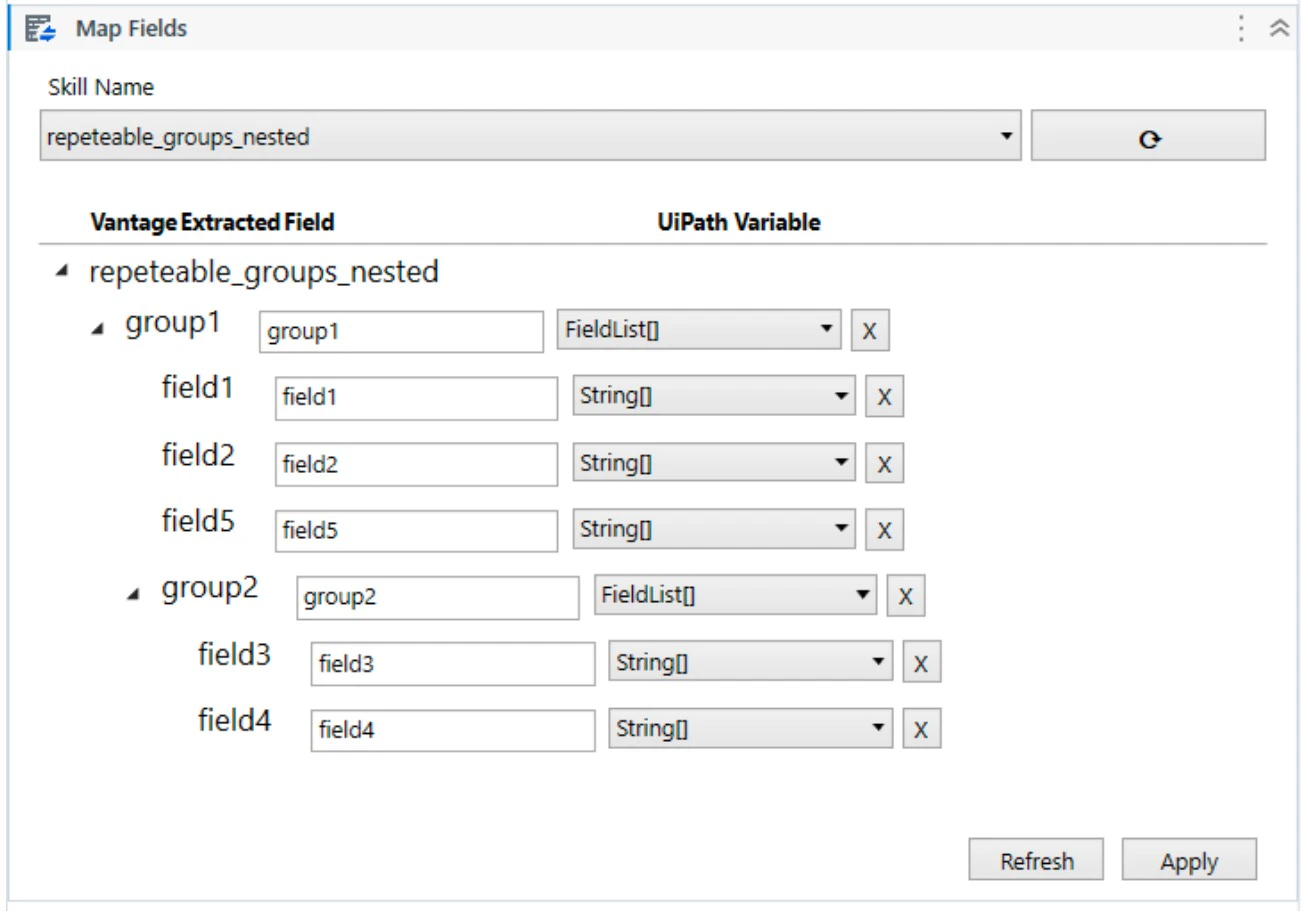
Map Fields activity showing the Vantage Extracted Field tree and UiPath Variable column with mapped groups and repeatable fields

GroupItem

GroupItem is a structure containing one instance of some repeating object (field or group of fields).
Method/PropertyParameterTypeDescription
KeysIEnumerable<string>Key values. Each value is the name of a specific nesting level.
ValuesIEnumerable<IReadOnlyList<FieldList>>Set of field values of nesting levels.
CountIntegerNumber of nested fields.
ContainsKeyKey: StringBooleanSpecifies if a nested field exists.
TryGetValueKey: String, Value: IReadOnlyList<FieldList>BooleanSpecifies if a value exists. If there is a value, returns True and the value, otherwise returns False.
this[]Name: StringIReadOnlyList<FieldList>Returns the value of the specified nested field.
FindName: StringIEnumerable<FieldList>Finds all nested fields of any nesting level with the specified name.
FilterPredicate: (Name: String, Node: FieldList) => BooleanIEnumerable<FieldList>Finds all nested fields of any nesting level that satisfy the predicate.
DescendentsNameItems: Params String[]IEnumerable<FieldList>Finds all nested fields of any nesting level whose name matches the nameItems parameter.

FieldList

FieldList is a structure that corresponds to a field or group of fields (repeating fields or repeating groups with the same name) and contains the values (multiple instances possible) of the fields or groups.
Method/PropertyParameterTypeDescription
ValuesIEnumerable<Object>Set of scalar field values.
CountIntegerNumber of nested GroupItems.
FindName: StringIEnumerable<FieldList>Finds all nested fields of any nesting level with the specified name.
FilterPredicate: (Name: String, Node: FieldList) => BooleanIEnumerable<FieldList>Finds all nested fields of any nesting level that satisfy the predicate.
this[]Num: IntegerGroupItemReturns the GroupItem with nested fields (if any) at the number of the num parameter.
The Sample Process provides an example of using a variable with the FieldList[] type (the Description column of the LineItems table is displayed in the log messages).
For more information about the Group field type, see Group field.

Vantage Scope activity

Pass ABBYY Vantage connection settings to nested Vantage activities.

Use Skill activity

Create a Vantage transaction to process a document with a skill.

Get Results activity

Retrieve the processing results from ABBYY Vantage.