
How the Exclude function removes regions from a search area
TheExclude function excludes a region from the search area of an element. The region to exclude is specified when calling the function.
The excluded region can be any of the following:
- The region of a hypothesis (detected or not)
- A rectangle or an array of rectangles of the found elements
- A region built from the regions of objects that are part of a found hypothesis (see the
ExcludeSetmethod)
The Exclude.fsp sample project
TheExclude.fsp project (folder %public%\ABBYY\FlexiCapture\12.0\Samples\FLS\Tips and Tricks\Exclude) shows how the Exclude function works.
The project has four pages:
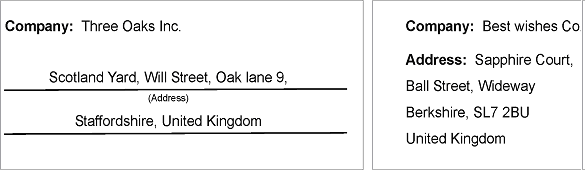
- Page 1 – The address field spans several lines. The name Address: is in the first line, so the data field cannot be described as located to the right of or below the field name. However, the name still has to be excluded from recognition.
- Page 2 – The address field has no name.
- Pages 3 and 4 – The line (Address) lies within the data field. However, it has to be excluded from recognition.
Create elements for the field names and the address field
First, create a Static Text element, name it CompanyHeader, and specify its value. This element is used to detect the name of the field. Next, create a Static Text element and name it AddressHeader. This element is used to detect the name of the field. Specify the following static text values: Address:|(Address), that is, list all the variants of this line that should be detected and then excluded from recognition in the address field. Describe the search constraints for these lines in the Relations field and specify that these lines should be looked for below (Below) the CompanyHeader element.The element for the name must be created before the element for the address field, because the
Exclude function only allows referring to elements that are higher up in the FlexiLayout tree than the current element.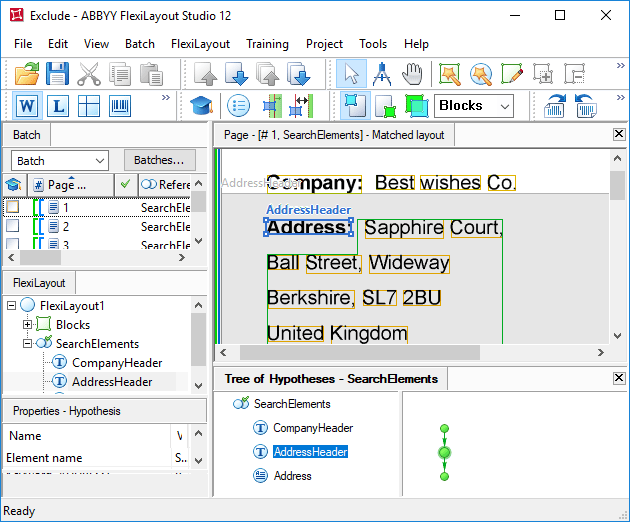
Exclude the field name from the Address search area
Now go back to the Properties dialog box of the Address element and click the Search Constraints tab. Click Add… next to the Exclude regions of elements section and choose the AddressHeader element from the list.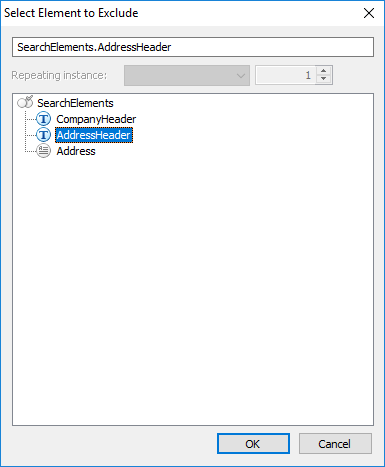 | 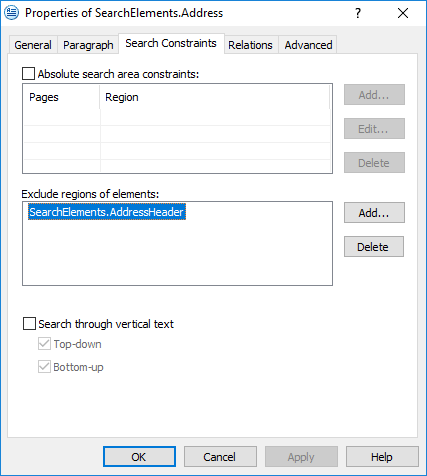 |
|---|
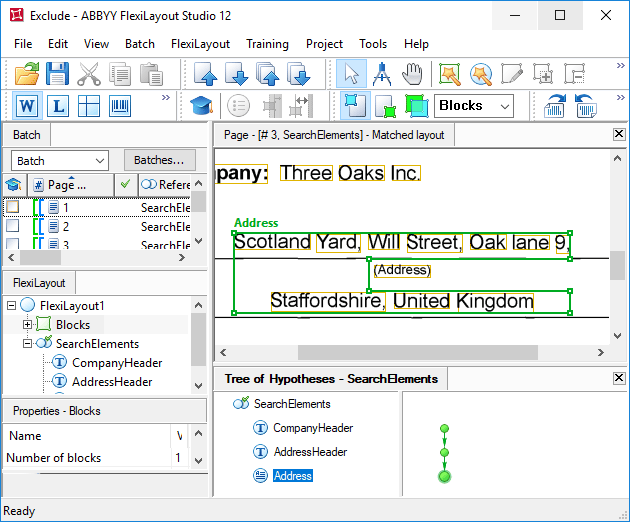
The Exclude regions of elements section allows you to exclude the region of a found hypothesis for another element from the search area of the current element. To exclude a more geometrically complex area, or to detect a region first and then exclude it from the recognition process, use the functions
Exclude, ExcludeRect, and ExcludeSet in the Advanced pre-search relations field.The region of a block by definition consists of rectangles placed one upon another, so any horizontal line can cross the region only once, that is, there can be no vertical “teeth” jutting out.Therefore, if the line to be excluded and the required information are located on the same or roughly the same level, the name cannot be excluded at the stage of FlexiLayout creation. In that case, the name can be excluded after recognition in FlexiCapture by using the Substitute from the list rule.