
- The name of the Invoice Date field is the short and very common word
Date, so narrow the search area as much as possible. - If this field is present, its name appears very close to the name of the Invoice Number field.
Create the kwInvoiceDate element
1
Create the Static Text element
In the InvoiceHeader element, create a Static Text element and name it kwInvoiceDate.
2
Enter the search text
Click the Static Text tab. In the Search text field, type
Date.3
Set the maximum error percentage
Set Max error percentage to 30, which allows only one error in the four-letter word.
4
Add position relations
Click the Relations tab, click Add, and add relations specifying that the keyword may be no more than 30 dots above the upper boundary of the Invoice Number field name and no more than 700 dots below its lower boundary:
- Below the upper boundary of the kwInvoiceNumber region, Offset = -30, Reference boundary = Top.
- Above the lower boundary of the kwInvoiceNumber region, Offset = -700, Reference boundary = Bottom.
5
Match the FlexiLayout
Temporarily exclude the InvoiceFooter element and match the FlexiLayout.
- On the first page of some documents, several hypotheses are generated for kwInvoiceDate, and sometimes the wrong one is selected. Adjust the element properties to correct the error.
- The field of interest is closest to the upper edge of the page.
Add search constraints to kwInvoiceDate
1
Open the element properties
Open the Properties dialog box for the kwInvoiceDate element.
2
Set the Nearest constraint
Click the Relations tab, select Nearest, and select Page top edge from the To drop-down list.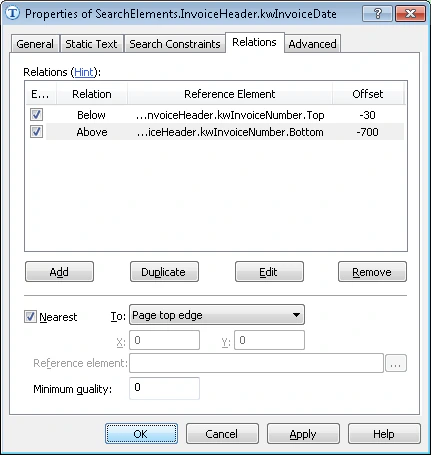
3
Verify the match
Match the FlexiLayout again to confirm that the name of the Invoice Date field is detected reliably.