
- On some documents, the Invoice Date field appears to the right of the field name; on others, beneath the name. Limit the search area to rectangles to the right of and beneath the name.
- Use a Date element to search for the date. Additionally, if the field name is not detected, do not search for the field data.
- Dates are often recognized unreliably, because of scanning defects, invalid date formats, and so on. Specify an additional Character String element in case the Date element fails to find a date.
Create the grDate group element
1
Create the Group element
In the InvoiceHeader element, create a Group element and name it grDate.
2
Restrict the search area
Click the Advanced tab and specify additional search constraints: limit the search area to an array of rectangles consisting of one rectangle to the right of the field name and one rectangle below the field name with some offset. In the FlexiLayout language:
Create the InvoiceDate element
1
Create the Date element
In the
InvoiceHeader.grDate element, create a Date element and name it InvoiceDate.2
Specify the date formats
Click the Date tab and specify all the possible date formats for the InvoiceDate element: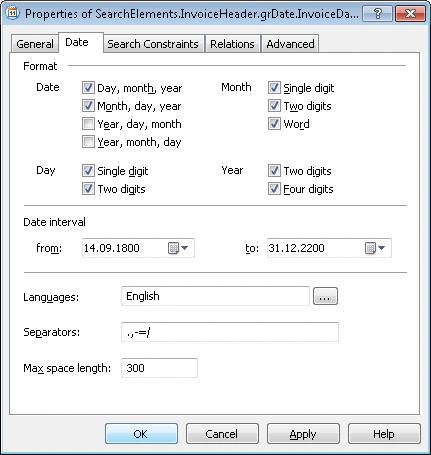
3
Exclude the already detected elements
On some images, the search area for the Invoice Date field includes the already detected kwInvoiceNumber and InvoiceNumber elements. To prevent FlexiLayout Studio from treating their values as hypotheses for the Invoice Date field, exclude them from the search area:
- Click Add… next to the Exclude regions of elements field.
- Select kwInvoiceNumber from the list of elements.
- Click OK. The string
SearchElements.InvoiceHeader.kwInvoiceNumberappears in the Exclude regions of elements field.
SearchElements.InvoiceHeader.InvoiceNumber.4
Add the search constraint
Click the Advanced tab. The Invoice Date field is optional. However, when a document contains a date in the Invoice Date field, the corresponding field name (described earlier by the kwInvoiceDate element) is always present. In Advanced pre-search relations, add this condition: search for the image object only if kwInvoiceDate was detected. In the FlexiLayout language:
5
Match the FlexiLayout
Temporarily exclude the InvoiceFooter element and match the FlexiLayout.
Create the InvoiceDateAsString element
1
Create the Character String element
In the
InvoiceHeader.grDate element, create a Character String element and name it InvoiceDateAsString.2
Specify the alphabet
Click the Character String tab and specify the alphabet:
,-./0123456789ABCDEFGHIJKLMNOPQRSTUVWXYZ abcdefghijklmnopqrstuvwxyz3
Set the non-alphabet character percentage
Set the percentage of non-alphabet characters to 30%.
4
Set the character count
In the Character count field, specify the fuzzy interval
{-1, 8, 14, INF} for the length of the character string, assuming that possible values fall in the range of 8 to 14 characters. Any hypothesis outside this interval is penalized.5
Set the maximum space length
Set Max space length to 20, which limits the maximum length of a space in the text string to 20 dots. Keep the default settings for the other element properties.
6
Add the fallback constraint
Click the Advanced tab. Because the InvoiceDateAsString element must be searched for only when the InvoiceDate element is not detected, specify this condition in the Advanced pre-search relations field. In the FlexiLayout language:
7
Add the location constraint
Specify an additional condition, similar to the one for InvoiceDate: search for the image object only if the kwInvoiceDate element was detected, and search for the object closest to kwInvoiceDate. In the FlexiLayout language:
8
Set the block region
Specify the location of the InvoiceDate block as the rectangular region of the detected InvoiceDate or InvoiceDateAsString element, increased by 5 dots vertically and horizontally. Select the Expression option and type this expression: