
 in the FlexiLayout tree.
The program uses Separator elements to look for separators. It considers as candidates those separator objects detected during pre-recognition that either fit entirely within the search area of a Separator element or overlap the search area.
in the FlexiLayout tree.
The program uses Separator elements to look for separators. It considers as candidates those separator objects detected during pre-recognition that either fit entirely within the search area of a Separator element or overlap the search area.
Separator element properties
To open the Properties dialog box, right-click the element in the FlexiLayout tree and select Properties… on the shortcut menu. Click the Separator tab to describe the corresponding object.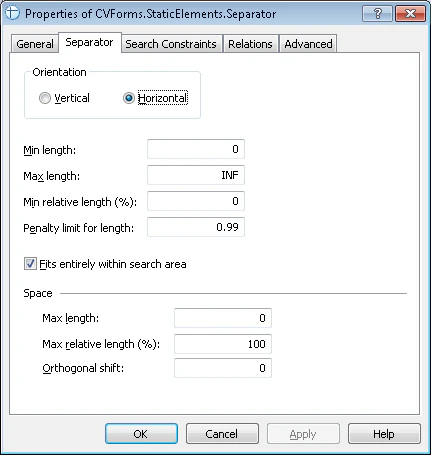
If you specify both Min length and Min relative length (%), the program uses the stricter criterion and ignores the other.
Penalty limit for length
Penalty limit for length is the minimum coefficient by which the hypothesis quality can be multiplied as a penalty for its length. When the program estimates the quality of a hypothesis, it can penalize the hypothesis for the length of the separator: the longer the separator object, the higher the quality of the hypothesis. The highest quality of 1 is assigned to a separator whose length is the same as the search area. When the relative length of the separator decreases from 1 to 0, the quality of the hypothesis decreases in direct proportion from 1 to the Penalty limit for length value.| Diagram | Formula |
|---|---|
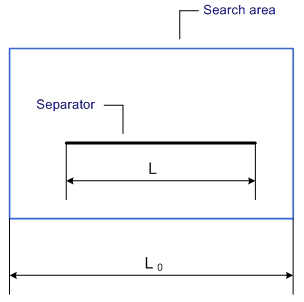 | Relative length = L/L0 |
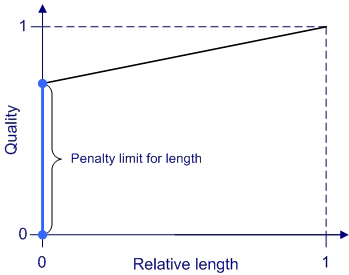 | [Quality] = ( 1 – [Min penalty for length] ) * [Relative length] + [Penalty limit for length]. (The quality changes linearly from 1 for a relative length of 1 to [Min penalty for length] for a relative length of 0.) |
Fits entirely within search area
Fits entirely within search area specifies that the separator must fit entirely within its search area. Clear this option to find separators that overlap the search area, as shown in the following figure.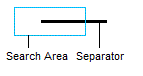
Space group for disjointed separators
Sometimes separators on document images become distorted, disjointed, or skewed due to low-quality printing or scanning. During pre-recognition, this can cause the program to detect multiple separators instead of one.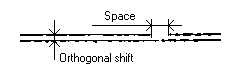
If you specify both Max length and Max relative length (%), the program uses the shorter of the two distances.
Tips for Separator elements
Separators do not usually have fixed positions on unstructured documents. Since they are optional design elements, a designer might choose not to use them at all. For this reason, separators are rarely used as reference elements in FlexiLayouts. The most common function of separators in documents is to separate the text from adjoining fields, so the search areas of Separator elements tend to be small. If you use separators as reference elements, check whether they were detected during pre-recognition. After pre-recognition completes, confirm that the program can detect a separator on all test images.1
Highlight the separators
Click the  button on the toolbar.
button on the toolbar.2
Review every test image
Look through all of the test images and check the location of the separators.