
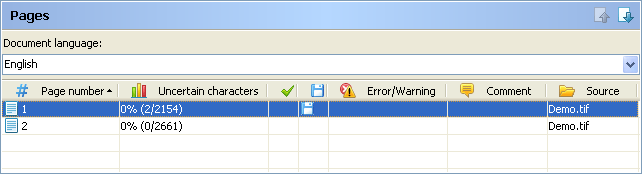
- Details view
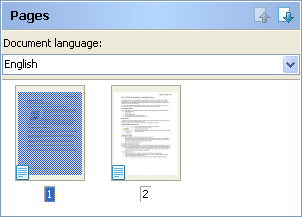
- Thumbnails view
Properties
Name | Type | Description |
|---|---|---|
Specifies the active page in Document Viewer. If there is no active page, the value of this property is 0. | ||
Specifies whether the caption pane of Document Viewer is enabled. If this property is FALSE, caption pane is not displayed. By default, the value is TRUE. | ||
Specifies whether the context menu of Document Viewer is enabled. If this property is FALSE, context menu is never displayed. By default, the value is TRUE. | ||
Provides access to the commands available in Document Viewer. See the list of commands available in Document Viewer. | ||
Specifies the document connected to Document Viewer. | ||
Specifies whether the language page of Document Viewer is enabled. If this property is FALSE, language page is not displayed. By default, the value is TRUE. | ||
Specifies whether Document Viewer is locked. This property is useful in the following situations:
In this case, we recommend that you set this property to TRUE before analysis, recognition, synthesis or export, and set it to FALSE after the end of the operation. In this case, the document cannot be spoilt from Document Viewer. By default, the value is FALSE. | ||
Specifies the current mode of Document Viewer: Details or Thumbnails view. By default, the mode is DVM_Thumbnails. | ||
Provides access to the settings of the context menu. | ||
Specifies the default processing parameters for the document. These parameters are used if the analysis and recognition processes are called directly from Document Viewer. If Document Viewer is connected to Component Synchronizer, use the IComponentSynchronizer::ProcessingParams property to change parameters used for processing. If you change processing parameters via the property of Document Viewer, errors may occur. | ||
Specifies the title of the Document Viewer component. By default, it is “Pages”. | ||
Provides access to the toolbar settings. | ||
Provides access to the collection of indices of selected pages. | ||
Specifies the path to the folder which contains files with the settings of Document Viewer. Other Visual Components have the same property. Each Visual Component should use its own folder with settings. The value of this property is constructed from the path to the folder, in which ABBYY FineReader Engine stores user-specific data, and the name of its subfolder. By default, the folder with user-specific data is the FineReader Engine data folder. It can be changed during initialization of FineReader Engine (via the InitializeEngine function, or via the IEngineLoader::InitializeEngine method). The default name of the subfolder is an arbitrary GUID. To change the name of the subfolder, you should specify the new name in the properties of the component in Visual Studio at design time. If you try to specify the value of the property at run time, this value is ignored. If you add the component to a form in Visual Studio when designing, the value of the property is defined either automatically with the default value, or manually with a custom value. In both cases the value is defined at design time. If for some reason the value of the property is not defined at design time (e.g., if you generate the component dynamically at run time), the component creates a new folder with the settings each time the component is initialized. To avoid multiplication of the folders, you should delete the created settings folder after the component deinitialization. In this case, you can use only the default settings of the component and cannot save the settings between sessions. | ||
__int64, read-only | Returns the window handle of the client area. |