Even though the YOUR PLANET NAME field is preceded by the NAME field, the FlexiLayout must search for the YOUR PLANET NAME field first. This excludes the ambiguity that can arise if the FlexiLayout looks for the NAME field first. Because the word NAME appears in both field names, the program formulates several hypotheses if you instruct it to look only for the word NAME without additional constraints. To avoid this ambiguity, the program must look for the YOUR PLANET NAME field first and only then for the NAME field. In Step 15, you impose additional constraints on the NAME field.

Create the PlanetNameHeader element

1

Create the Static Text element

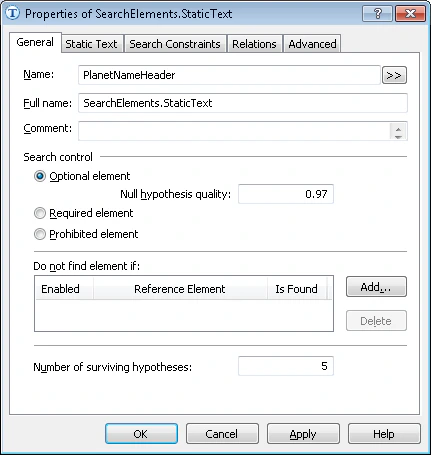
Create an element of type Static Text and name it PlanetNameHeader.Do not select Required element, which is not selected by default. Unlike the document heading, which is used as a document identifier and for this reason was specified as a required element, all the other elements are optional. This allows the program to formulate null hypotheses even for elements for which it fails to find the corresponding objects on the images.
Screenshot of the General tab of the Static Text element properties in ABBYY FlexiLayout Studio showing the element named PlanetNameHeader with the Required element option cleared.
2

Open the Static Text tab

Click the Static Text tab.
3

Enter the search text

In the Search text field, type the text to search for. Because the field name appears on a single line in all the test images, you can type it without spaces: YOURPLANETNAME.
4

Set the maximum error percentage

Set Max error percentage to 20, because the field name has more than one word and is fairly long.

Match the FlexiLayout against the test images

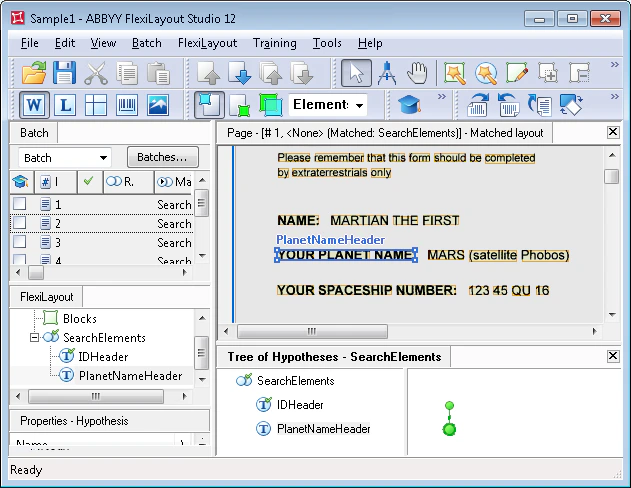
Try matching the FlexiLayout with the test images and make sure that the program successfully finds the YOUR PLANET NAME field on all the images.
Screenshot of ABBYY FlexiLayout Studio after matching, showing the YOUR PLANET NAME field successfully detected by the PlanetNameHeader element on a test image.